Posts

Showing posts with the label space

Astronomy Primer: Finding your directions in the sky
Image
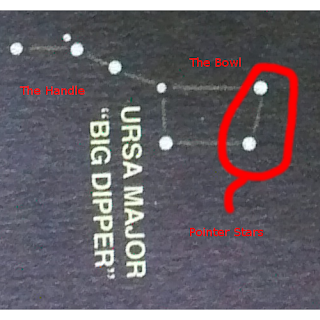
Have you ever looked up into space and wondered just how big the universe actually is?  If the answer is no I encourage you to do so.  Some easy things to learn that will help you in your navigation of the night sky is your directions.  The easiest way to do this is by finding the big dipper. The big dipper is a circumpolar constellation, meaning that it never sets in our night sky.  The dipper is a bright easy to see constellation. Look for the bowl and handle. The next thing to find is the north star; take the front two stars of the big dipper and go until you run into the end of the little dippers handle.  That star is polaris also known as the North Star. If you were to extend the Earth's north pole into space it would run into Polaris.  Now you can observe the path of the stars over the course of an evening.  You will notice stars rise in the the East and set in the West, now that you have located your directions it will be ea...

Perseids Meteor Shower

Just a heads up to everyone, the Perseid Meteor shower which can be seen through much of August will be peaking this weekend! (August 11-12).  If you are observing in the right conditions you could see up to sixty meteors an hour. How do you observe this meteor shower?  Make sure you head out to a location with very little light pollution.  Out in the country is by far the best place for that sort of thing; however a large city park with few streetlights would be the next best option for the city dweller.  The best time to start looking for meteors will be around midnight, if you can you should be looking towards the eastern horizon about halfway up the sky. The meteors will seem to be originating from the constellation of Perseus.  An easy way to find Perseus is to look for the Milky Way in the sky, then locate the large W shaped constellation (Cassiopeia) and look north of that constellation.  Perseus is a harder constellation to see because of his ab...

Curiosity has landed!

Image
Hopefully you all have heard that the newest rover sent to Mars by NASA has landed safe and sound.  This is an awesome moment and hopefully the start of a long and successful mission!  I for one am extremely excited to see what the rover can find.  The rover touched down in the Gale crater near the equator. Now the rover will begin its examination of the martian soil looking for evidence of martian life in the past or even the present.  The rover was in development for about ten years before landing.  I sadly missed the live landing but I did watch the recording of the control room and watched the frame by frame on NASA TV.  It is good to see that some government funding is being spent for a good purpose. Lets raise a glass to the people who made this mission possible and succeeded in landing the one ton rover right on target! Curiosity Descent (YouTube) Image of Curiosities descent NASA/JPL-Caltech/Univ. of Arizona Taken by  NASA's Mar...

Mars Rover: Curiosity

Image
Curiosity Rover. Image from JPL/NASA. An exciting time is soon approaching.  The latest rover mission from NASA Curiosity will arrive at the red planet on August 6th 2012.  Curiosity is a mobile laboratory and is also much larger (5x massive) than the previous rovers (Spirit and Opportunity, launched in 2003).  It will be equipped with 10 science instruments in order to analyze the soil, and the atmosphere of Mars.  Curiosity will be searching for evidence of the habitability of Mars in the past.  I am excited for the landing and the start of the ground mission! Want to watch the landing live? NASA JPL Live (landing is scheduled for 1:31 AM EDT 08/06/2012) NASA TV UStream Sources: JPL Curiosity Website Mission Brief